Best time to visit Karkonosze: weather and crowds by month
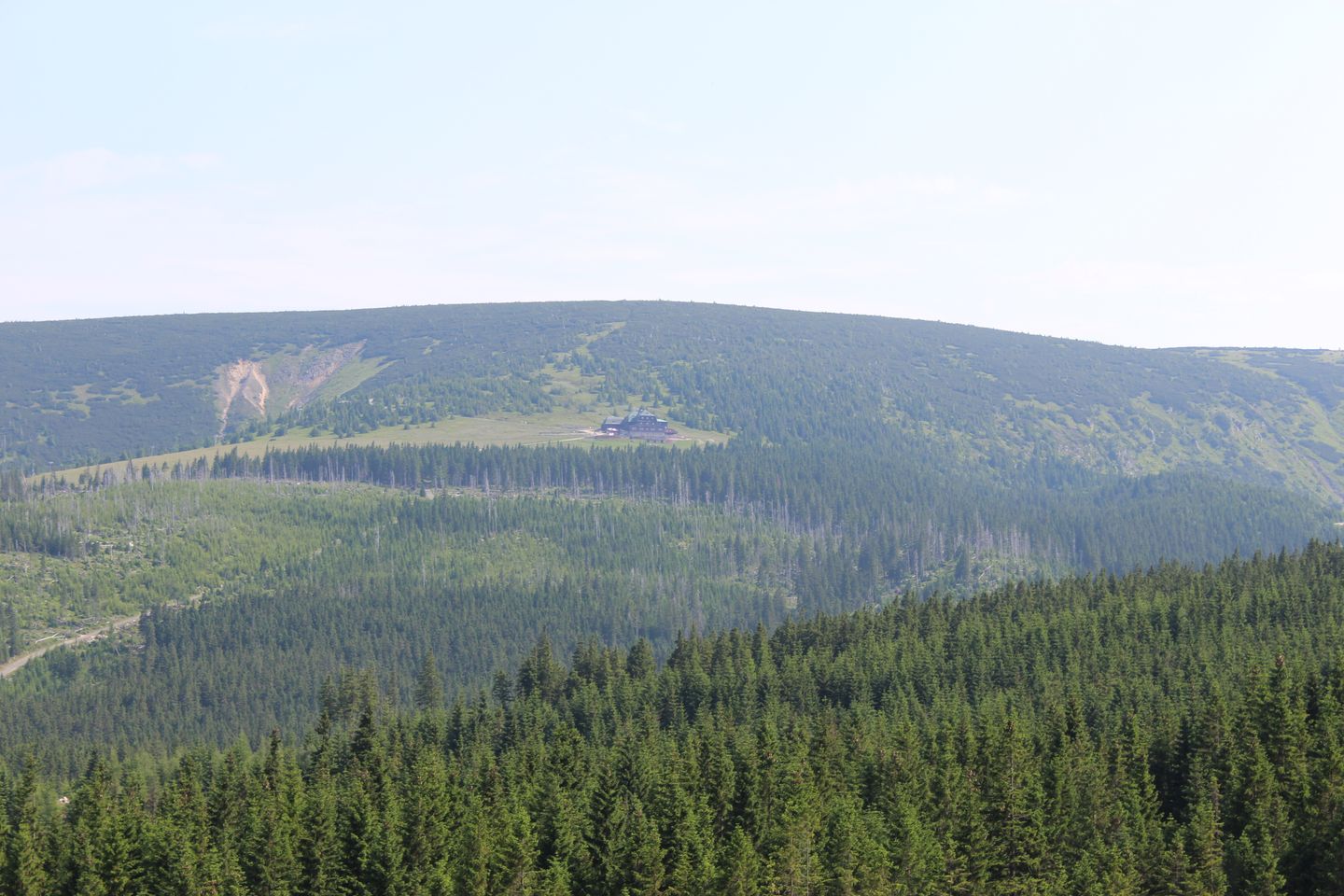
For walking the main ridge I recommend late August and September: August has the fewest days of fog and strong wind on Śnieżka (Sněžka) of the whole year, and September in the Jelenia Góra Valley is noticeably drier than July (the rainiest month) and the summer crowds have gone. Snow in the valley is a lottery (Jelenia Góra averages 17 days with snow cover in January), but on the ridge it lies from November to April, and in May it still averages around 10 days. I lived in Jagniątków for 20 years, and the main thing those years taught me is not to judge the Karkonosze (Giant Mountains) by the weather outside your window: on a day when it’s 1°C lower down, Śnieżka can be −6°C with a wind chill of −17°C (that’s what the KPN bulletin said on the day I wrote this, 22 November 2026). Below you’ll find the figures for both altitudes, a crowd calendar for 2027 and the trail closures that surprise visitors every year.
In short (as of 11.2026)
- Views from the ridge: August (least fog and wind on Śnieżka).
- Walking without crowds or heavy thunderstorms: September.
- Snow in the valley: unreliable, Jelenia Góra averages 17 days with snow cover in January; on Śnieżka snow lies from November to April.
- KPN closures: avalanche closures in winter depending on conditions, bird-breeding closures in spring – according to KPN for no less than 15 March to 31 May.
- Busiest periods 2026/2027: 23–31 December, Polish winter school holidays 18 January – 28 February, the May bank holiday weekend, Corpus Christi, summer holidays 26 June – 31 August.
- Data: 1991–2020 averages from IMGW data, Jelenia Góra and Śnieżka stations.
Where the figures in this article come from
All the weather data are 1991–2020 averages that I calculated from the monthly synoptic data of IMGW-PIB (the Polish national weather service) for two stations: Jelenia Góra (342 m above sea level, on the valley floor) and Śnieżka (1603 m, the observatory on the summit). The station altitudes come from the Statistical Office in Wrocław. These aren’t the official climate normals published by IMGW, just averages from the institute’s raw data, so they may differ from those by a few tenths of a degree.
Jagniątków lies in the highest part of Jelenia Góra, at the foot of the Karkonosze, higher than the station on the valley floor. It has no IMGW station of its own, so the nearest reference point in the table is Jelenia Góra. In my experience Jagniątków gets a bit more snow and is a bit colder than Jelenia Góra, but not dramatically so.
Weather in the valley and on Śnieżka – 12-month table
The difference in average temperature between the valley and the summit ranges from about 5°C in winter to 8°C in spring and summer, and the ridge gets half as much precipitation again. The maximum temperature is the average of daily highs, so roughly what the thermometer shows in the afternoon.
| Month | Jelenia Góra: avg / max / min °C | Jelenia Góra: precipitation mm | Jelenia Góra: days with snow cover | Śnieżka: avg / max °C | Śnieżka: precipitation mm | Śnieżka: days with snow cover | Śnieżka: days with fog |
|---|---|---|---|---|---|---|---|
| January | −1.3 / 2.8 / −5.5 | 40 | 17 | −5.9 / −3.3 | 107 | 31 | 27 |
| February | −0.2 / 4.2 / −4.5 | 35 | 14 | −6.2 / −3.7 | 89 | 28 | 25 |
| March | 2.9 / 8.1 / −1.9 | 48 | 8 | −4.3 / −1.9 | 88 | 31 | 28 |
| April | 7.9 / 14.0 / 1.6 | 42 | 2 | 0.0 / 2.7 | 51 | 28 | 23 |
| May | 12.4 / 18.4 / 6.1 | 72 | 0 | 4.4 / 7.4 | 78 | 10 | 24 |
| June | 15.8 / 21.7 / 9.6 | 84 | 0 | 7.7 / 10.7 | 98 | under 1 | 25 |
| July | 17.6 / 23.8 / 11.4 | 110 | 0 | 9.8 / 12.7 | 121 | 0 | 24 |
| August | 17.1 / 23.7 / 10.8 | 88 | 0 | 9.9 / 12.8 | 95 | 0 | 23 |
| September | 12.6 / 18.6 / 7.2 | 65 | 0 | 5.8 / 8.3 | 87 | 1 | 25 |
| October | 8.3 / 13.6 / 3.4 | 48 | under 1 | 2.1 / 4.6 | 80 | 8 | 27 |
| November | 3.6 / 7.9 / −0.6 | 39 | 5 | −1.6 / 1.0 | 83 | 19 | 27 |
| December | −0.1 / 3.6 / −4.1 | 37 | 13 | −4.7 / −2.2 | 114 | 29 | 27 |
| year | 8.0 | 707 | 60 | 1.4 | 1091 | 186 | 304 |
The most useful column for planning is fog: Śnieżka is in cloud on average 304 days a year (the station records fog on those days), so a view from the summit isn’t guaranteed in any month. August and April give you the best odds. On the ridge the wind blows hard for most of the year: Śnieżka has 221 days a year with wind above 15 m/s, from 24 in December to 12 in August. July is the wettest month in the valley and on the summit, and it also has the most thunderstorms: Jelenia Góra averages 6 days with a thunderstorm in July and 5 in June and August.
Recent years have been warmer than the 1991–2020 average. In 2015–2024 (with incomplete data for 2024) the annual average in Jelenia Góra was 8.9°C instead of 8.0°C, and the town averaged 7 days with snow cover in February instead of 14, and 8 in December instead of 13. Śnieżka lost only a few days of snow cover: around 179 a year instead of 186. So if you want snow on a winter trip, look at the higher parts of the mountains, not the valley.
When it’s crowded – 2027 calendar
The most people come during the winter school holidays, the summer holidays and long weekends. Dates for the 2026/2027 school year according to the Polish Ministry of Education calendar:
| Dates | Why it’s busy |
|---|---|
| 23–31 December 2026 | Christmas school break, then New Year’s Eve |
| 18 January – 28 February 2027 | Polish winter school holidays in three rounds, different for each region – details in my article on 2027 winter holiday dates in the Karkonosze |
| 25–30 March 2027 | Easter school break, Easter Sunday on 28 March |
| 1–3 May 2027 | the May bank holiday weekend (Saturday – Monday) |
| 27–30 May 2027 | Corpus Christi on Thursday, a long weekend with 1 day of leave (Friday 28 May) |
| 26 June – 31 August 2027 | summer school holidays |
| 30 October – 1 November 2027 | All Saints’ Day on Monday |
| 11–14 November 2027 | Independence Day on Thursday |
The busiest spot is Śnieżka, while Jagniątków is quieter than Karpacz and Szklarska Poręba all year round. If you can choose, go midweek outside the dates in the table.
Closed trails: winter and spring are two different reasons
KPN (Karkonosze National Park) closes trails for two different reasons. In winter, closures depend on avalanche danger and have no fixed dates. In spring, sections in the glacial cirques and on the ridges are closed because of black grouse and peregrine falcon breeding – according to KPN, “regularly for a period no shorter than from 15 March to 31 May”.
Winter: avalanche closures depending on conditions
KPN closes the at-risk sections depending on the weather and snow depth, and the avalanche danger level is announced by the Karkonosze Group of GOPR (the Polish mountain rescue). Decisions are made day by day. In November 2026 the KPN tourist bulletin was still saying it was “not possible to determine the avalanche danger level” with 10–30 cm of snow on the ridge. As an example, on 6 January 2026 closures included the red trail through Kocioł Łomniczki, the blue Droga Jubileuszowa (Jubilee Road; for Śnieżka the bulletin sent people up the red Zakosy zigzags instead), the yellow trail through Biały Jar, the blue trail through Kocioł Małego Stawu and the green trail through Śnieżne Kotły. Some of the closed sections have winter bypasses marked with poles.
More than 40 km of trails above the tree line are marked with poles (KPN). The park says plainly that you’re safe on them in difficult conditions, so in fog or a blizzard stick to the poles.
From 15 March: black grouse and falcon breeding
The spring closures happen every year, although the start date has changed: the blog Hasające Zające wrote in 2023 about a period starting on 1 April, while in 2024 and 2026 the closures began on 15 March. In 2026 they applied from 15 March until at least the end of May (a KPN notice passed on by PTTK Sudety Zachodnie, confirmed by RMF24). The closed sections were:
- the green trail from Mokre Rozdroże through Śnieżne Kotły to Rozdroże pod Wielkim Szyszakiem,
- the yellow trail from Mokre Rozdroże above the Pod Łabskim Szczytem hut to Śnieżne Kotły,
- the green trail from Czarny Kocioł Jagniątkowski to the black trail, via Petrówka, to the Bażynowe Skały junction,
- the green trail (Droga nad Reglami) from Pielgrzymy to Rozdroże pod Małym Szyszakiem by the Odrodzenie hut,
- the blue trail through Kocioł Małego Stawu, from Domek Myśliwski to Samotnia,
- the green trail from Polana over the moraine of Kocioł Wielkiego Stawu to the red main ridge trail,
- the blue trail from Przełęcz Okraj over Czoło and Kowarski Grzbiet to Skalny Stół.
If you’re starting from Jagniątków, this list matters: the first three sections run through Śnieżne Kotły and from Czarny Kocioł Jagniątkowski, so they affect the walks I describe in my articles on Śnieżne Kotły from Jagniątków and Czarny Kocioł Jagniątkowski. In spring you can’t walk these sections. KPN announces the reopening in a bulletin, there’s no fixed date. If you’re coming at the end of May or in early June, check the map of closed trails before you plan your route.
The park entry ticket applies all year round; prices and exemptions are in my article on Karkonosze National Park tickets.
December, January, February: winter on the ridge, mixed in the valley
On the ridge it’s full winter: Śnieżka averages −6 to −5°C, snow lies almost every day, and there are 21–24 days a month with wind above 15 m/s. In Jelenia Góra the average temperature hovers around zero, and snow cover lasts on average 13–17 days a month, less in recent years. If you want to be sure of walking on snow, go higher: cross-country skiing in Jakuszyce or the upper parts of the mountains, rather than counting on a snowy valley.
In winter I’d only go up to the ridge with a good forecast, with microspikes and in boots with a stiff sole, because that’s the kit KPN lists as basic (on steep icy sections you may need crampons). The park also reminds you that on trails inside the park you’re not allowed to sledge or ride plastic saucer sledges. I’d avoid the winter school holidays and the Christmas period if you want empty trails. In 2027 the holidays for Lower Silesia fall in the first round (18–31 January), but visitors from other regions keep coming until the end of February. It’s quietest between the end of the winter holidays and the Easter break.
March and April: winter up high, spring down below
In March Śnieżka averages 31 days with snow cover out of a possible 31, in April 28 out of 30, and the average April temperature on the summit is 0°C. At the same time Jelenia Góra averages 14°C on an April afternoon. On top of that, from 15 March the breeding closures cover some of the routes in the cirques.
I recommend this time of year to people who are happy with lower forest trails and don’t need Śnieżne Kotły. Up high you still need winter kit. For rainy days there’s my list of indoor attractions in the Karkonosze, and for tired legs the Cieplice thermal baths.
May and June: green in the valley, still snow on the ridge
In May the valley averages 18°C in the afternoon, while on Śnieżka snow still lies for around 10 days (the average maximum snow depth in May is close to 40 cm at the station). In June snow on the summit only turns up occasionally, although snowfall has been recorded on average on 2 days a month.
May also brings the May bank holiday weekend and Corpus Christi, and breeding closures apply in parts of the mountains. I think June before the summer holidays (until 25 June 2027) is one of the better times to come: the days are longest and there are fewer people than in July. The breeding closures last at least until the end of May, so in early June check whether KPN has reopened the routes in the cirques. You also need to reckon with thunderstorms.
July and August: summer holidays, storms and the biggest crowds
These are the warmest months: almost 24°C in the afternoon in Jelenia Góra, around 13°C on Śnieżka. July is also the wettest (110 mm in the valley, 121 mm on the summit) and has the most thunderstorm days. August has the fewest days of fog and strong wind on Śnieżka of the whole year, so it’s the best month for views from the ridge.
In summer 2024 KPN recommended one-way traffic on the trail to Śnieżka: up only via Zakosy, both directions on Droga Jubileuszowa. It was a recommendation with no fines, and the rangers didn’t enforce it. In November 2026 KPN states that the Zakosy trail is two-way. In summer I recommend setting off early in the morning so you have time in hand if you need to come down ahead of a storm. Swimming in mountain lakes and waterfalls inside the park is prohibited; KPN points you to streams outside the park.
September and October: my choice for walking
September is the best compromise: an average of 19°C in the valley in the afternoon, 40% less precipitation than in July, rare thunderstorms (1.4 days), and the summer holidays are over. Śnieżka still reaches 8°C in the afternoon and snow lies for only one day on average. If I had to pick one month for a first trip to the Karkonosze, I’d pick September.
October is cooler, and snow on the ridge becomes regular (on average 8 days with snow cover on Śnieżka). In Jelenia Góra, September and October have the most foggy days of the year (14 and 12), so mornings in the valley are often grey. From 30 October the All Saints’ long weekend begins.
November: the darkest and greyest month
I’d steer clear of November if you’re coming for the views. Jelenia Góra gets on average 77 hours of sunshine that month (234 in July), Śnieżka 68 hours and 27 days of fog. Winter starts on the ridge, but not yet in the valley: Jelenia Góra averages 5 days with snow cover.
The trail infrastructure also switches to winter mode. In November 2026 KPN announced that it had removed the chains around Śnieżne Kotły and Kocioł Małego Stawu, as well as the footbridge over the Łomniczka on the red trail. What November has going for it is the quiet, apart from the 11 November long weekend. In grey weather there are always the museums and pools in the area.
On the day you set off, check the KPN tourist bulletin with its map of closed sections, and in winter the GOPR avalanche bulletin too.
Checked: November 2026.